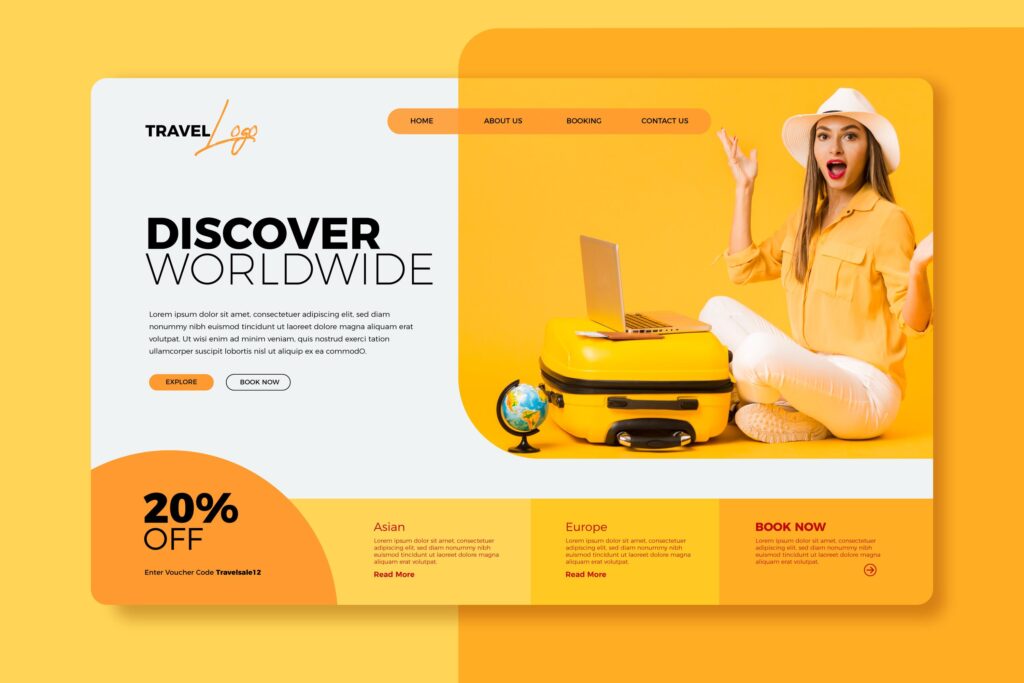
Most landing pages fail before anyone reads a single word.
Not because the traffic is wrong. Not because the offer is weak. But because the page was built around what the business wanted to say rather than how the human on the other side actually thinks, feels, and decides.
High-converting landing pages are not the result of better design software or a larger ad budget.
They are the result of understanding behavioral psychology and engineering every element of the page around it. When you align your page with how people actually make decisions, conversion stops being a mystery and starts being a predictable outcome.
Clarity Reduces Cognitive Load
The human brain actively avoids effort. When a page presents too many options, too much information, or an unclear next step, the brain defaults to the easiest decision available: leave.
This is cognitive overload, and it is one of the most common reasons high-converting landing pages outperform cluttered ones.
Every element competing for attention on a page is a decision the visitor has to make. Too many decisions create fatigue. Fatigue creates hesitation. Hesitation kills conversions.
The fix is not better design. It is radical simplicity.
Strong headlines that communicate one clear idea. A value proposition that answers “What is in it for me?” in a single sentence.
Focused messaging that eliminates anything that does not support the conversion goal. Minimal distractions that keep the visitor moving in one direction.
Confusion is the fastest conversion killer on any page. Clarity is its most effective antidote.
The Power of Immediate Relevance
You have approximately five seconds.
That is the window in which a visitor decides whether your page is worth their attention. If what they see does not immediately reflect what brought them there, they leave. It is that simple.
This is why message match matters so much. When someone clicks an ad about a specific problem and lands on a generic homepage, the psychological connection breaks instantly.
The visitor feels misled, even if the offer is exactly what they need.
High-converting landing pages create immediate resonance by:
- Mirroring the language of the ad or search query that brought the visitor in.
- Identifying the specific problem the visitor is trying to solve within the first few seconds.
Generic pages speak to everyone. Pages that convert speak to someone specific, about something specific, right now.
Trust Signals and Risk Reduction
Skepticism is the default state of every online visitor.
People have been burned by overpromising websites. They have learned to protect themselves. And before they take any action, their brain is running a quiet background check on whether you are credible enough to trust.
Trust signals exist to pass that check.
- Testimonials from real people with real results.
- Case studies that document specific outcomes.
- Certifications and credentials that validate expertise.
- Guarantees that reduce the perceived risk of acting.
- Authentic photography that shows real humans behind the business rather than generic stock imagery.
Every trust signal you add to a landing page is removing a reason not to convert. The more perceived risk you eliminate, the lower the barrier to action becomes.
Social Proof and Behavioral Validation
Humans are wired to follow other humans.
When we are uncertain about a decision, we look to what others have done. This is not weakness. It is a deeply embedded survival behavior. And it has a direct and measurable impact on landing page performance.
Reviews, star ratings, client counts, recognizable brand logos, and user-generated content all function as behavioral validation. They tell the hesitant visitor that other people have made this decision and it worked out. That signal reduces uncertainty and accelerates commitment.
The businesses with the highest-converting landing pages understand that social proof is not a nice-to-have section at the bottom of the page. It is a core conversion mechanism that belongs close to every call to action.
Urgency and Scarcity Applied Ethically
People delay decisions when there is no reason to act now.
Urgency and scarcity exist to address that tendency. When something is genuinely limited in time or availability, communicating that limitation gives the visitor a reason to decide today rather than come back tomorrow and never return.
The key word is genuinely.
Manufactured countdown timers and false scarcity claims do short-term damage to conversion and long-term damage to trust. Ethical urgency means communicating real constraints honestly, whether that is a limited number of client spots, a time-sensitive offer, or a deadline that actually exists. When urgency is authentic, it accelerates action. When it is fabricated, it erodes credibility.
Friction Reduction and Micro Commitments
Every field in a form is a reason to abandon it.
This is one of the most well-documented findings in conversion optimization. The more you ask from a visitor upfront, the fewer will complete the process. Reducing form fields, simplifying the steps required to take action, and removing every unnecessary obstacle between interest and conversion directly increases completion rates.
Micro commitment psychology takes this further.
- People who take small actions are more likely to take larger ones.
- A visitor who downloads a guide, watches a short video, or answers a single question has already begun the process of committing.
- Each small step lowers the psychological resistance to the next one.
High-converting landing pages are designed around this progression. They do not ask for everything at once. They earn commitment incrementally.
Emotional Triggers and Outcome Visualization
Features describe what something does. Emotions drive what someone does.
No one buys a service because of its technical specifications. They buy because they can visualize their life or business being better on the other side of that decision. High-converting landing pages understand this and lead with transformation rather than features.
Pain amplification acknowledges the cost of inaction. What happens if the visitor does nothing? What continues to go wrong? Future state positioning paints a specific, compelling picture of the outcome the visitor wants. Transformation messaging bridges the gap between where they are and where they want to be.
When a visitor can clearly see themselves on the other side of saying yes, the conversion decision becomes emotional rather than analytical. Emotional decisions are made faster and with more confidence.
Data-Driven Refinement
Psychology tells you how people behave. Data tells you how your specific visitors behave on your specific page.
No landing page is optimized on the first build. The highest converting pages in any industry got there through a disciplined cycle of testing, measuring, and improving.
- Heat mapping shows where visitors are looking and where they stop engaging.
- Scroll tracking reveals how far down the page most visitors actually get.
- A/B testing compares two versions of a headline, a CTA, or a layout to determine which one produces better results with real traffic.
- Behavior analysis identifies the specific points where visitors drop off and converts that insight into targeted improvements.
Conversion optimization is not a project. It is a practice.
Landing Page Performance Is Engineered, Not Guessed
Every element of a high-converting landing page, from the headline to the form to the final call to action, is either working with human psychology or against it. There is no neutral ground.
Clarity reduces friction. Relevance creates resonance. Trust removes hesitation. Proof validates decisions. Urgency motivates action. And data tells you what to fix next.
If your landing pages are generating traffic but not conversions, the problem is structural. And structural problems have structural solutions.
Contact Create The Movement today, and let us design a paid media and landing page strategy focused on qualified leads and measurable growth.
Phone: (918) 770-0211
Website: https://createthemovement.com